Skip to content

Best Electrical Testers and Multimeters for Homeowners

We earn a commission if you buy through links on this page, at no extra cost to you. It does not change what we recommend — see our affiliate disclosure. As an Amazon Associate I earn from qualifying purchases.

Most home electrical questions come down to three things: is this wire live, is this outlet wired correctly, and how much current is this circuit actually drawing. Each one has a different right tool, and buying the wrong one is why so many homeowners own a multimeter they have never used.

This page groups testers by the question they answer rather than by price. A non-contact voltage tester is a safety device you touch to a wire before you work on it. An outlet tester tells you whether the receptacle behind the faceplate was wired correctly. A clamp meter measures the current a circuit is pulling without breaking the circuit — the only practical way to check a real load at home.

None of these tools make unlicensed work legal. Verify what your jurisdiction lets a homeowner do, and treat every conductor as live until a tester you trust says otherwise.

How we picked

  • Answers a specific question a homeowner actually has
  • UL/ETL listed with a stated CAT safety rating for the voltages involved
  • Readable in a dark panel or crawlspace
  • Durable enough to live in a drawer for years between uses

We do not accept payment for placement and we do not publish star ratings we did not measure. Specifications come from each manufacturer's published spec sheet.

Side by side

ProductTypeBest forSafety rating
Klein Tools NCVT-3PNon-contact voltage testerConfirming a circuit is dead before you open a device or boxCAT IV 1000 V
Fluke 1AC-A1-II VoltAlertNon-contact voltage testerA simple, rugged live/dead check on 120 V and 240 V branch circuitsCAT IV 1000 V
Sperry Instruments GFI6302Receptacle testerChecking every outlet in a house quickly for miswiring
Klein Tools RT250Receptacle testerDiagnosing voltage drop or a flaky circuit, not just wiring order
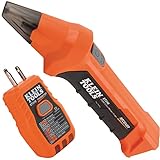
Klein Tools ET310Circuit breaker finderLabeling a panel without two people and a lot of shouting
Klein Tools MM400MultimeterA first multimeter that will not be outgrown for home workCAT III 600 V
Fluke 117MultimeterAnyone who will do this more than once a yearCAT III 600 V
Klein Tools CL800Clamp meterFinding out what a circuit or appliance is actually drawingCAT III 600 V
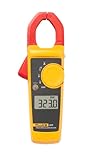
Fluke 323Clamp meterMeasuring current in a tight, densely packed load centerCAT IV 300 V / CAT III 600 V

The picks

#1 · Non-contact voltage tester

Klein Tools NCVT-3P

Check price on Amazon

Dual-range non-contact voltage pen with a built-in flashlight — the tool you touch to a wire before you touch the wire.

Best for: Confirming a circuit is dead before you open a device or box

Detection range
12–1000 V AC (dual range)
Indication
Audible beep + LED, with work light
Safety rating
CAT IV 1000 V
  • Dual range catches low-voltage doorbell and thermostat wiring, not just 120/240 V
  • Built-in flashlight matters more than it sounds — panels and crawlspaces are dark
  • Pocket clip means it is actually with you when you need it
  • Non-contact testers can miss voltage through thick insulation, conduit or a gloved grip
  • Tells you live/not-live only — no voltage reading
Read the full write-up →

#2 · Non-contact voltage tester

Fluke 1AC-A1-II VoltAlert

Check price on Amazon

The line-voltage-only VoltAlert pen, with a self-test that runs whenever the tip is near voltage.

Best for: A simple, rugged live/dead check on 120 V and 240 V branch circuits

Detection range
90–1000 V AC
Indication
Glowing red tip + beep
Safety rating
CAT IV 1000 V
  • Voltbeat self-test gives you a continuous confidence check on the tester itself
  • Very hard to kill — survives the toolbox
  • Unambiguous single-purpose readout
  • 90 V threshold means it ignores low-voltage control wiring entirely
  • No flashlight
Read the full write-up →

Three-light receptacle tester with a GFCI trip button — plug it in, read the light pattern off the label.

Best for: Checking every outlet in a house quickly for miswiring

Detects
Open ground, open neutral, open hot, reversed polarity, hot/ground reverse
GFCI test
Yes — trip button
Outlet type
120 V three-wire (NEMA 5-15)
  • Cheap enough that there is no reason not to own one
  • Finds the single most common defect in older homes: a three-prong outlet with no ground
  • Walking the whole house takes about ten minutes
  • Light patterns cannot distinguish a bootleg ground from a real one
  • No voltage reading — pass/fail only
Read the full write-up →

GFCI receptacle tester that adds an LCD showing the actual line voltage instead of just a light pattern.

Best for: Diagnosing voltage drop or a flaky circuit, not just wiring order

Display
LCD line voltage readout
Detects
Standard receptacle wiring faults
GFCI test
Yes — trip button
  • Seeing 108 V instead of 'correct' explains a whole class of dimming-lights complaints
  • Same one-second workflow as a three-light tester
  • Costs meaningfully more than a three-light tester for one extra number
  • Still cannot detect a bootleg ground
Read the full write-up →

#5 · Circuit breaker finder

Klein Tools ET310

Check price on Amazon

Transmitter-and-receiver pair that maps an outlet to its breaker, with a receptacle tester built into the transmitter.

Best for: Labeling a panel without two people and a lot of shouting

Method
Plug-in transmitter + handheld receiver
Extras
Built-in GFCI receptacle tester
Sensitivity
Adjustable, to narrow down adjacent breakers
  • Turns panel labeling from an afternoon into an hour
  • Doubles as a receptacle tester, so it replaces a tool rather than adding one
  • Adjacent breakers can both respond — you have to walk the sensitivity down
  • Tight, densely packed panels still take patience
Read the full write-up →

Auto-ranging digital multimeter covering AC/DC voltage, current, resistance, continuity, capacitance and temperature.

Best for: A first multimeter that will not be outgrown for home work

Voltage
Up to 600 V AC/DC
Measures
Voltage, current, resistance, continuity, capacitance, duty cycle, temperature
Safety rating
CAT III 600 V
  • Auto-ranging removes the main way beginners get a wrong reading
  • Capacitance and temperature cover most appliance-repair questions
  • Includes leads and a thermocouple in the box
  • Not true-RMS — readings on variable-speed and inverter-driven loads will be off
  • CAT III 600 V is fine at a panel but not for service-entrance work
Read the full write-up →

True-RMS electrician's multimeter with built-in non-contact voltage detection and a low-impedance mode that kills ghost voltage.

Best for: Anyone who will do this more than once a year

Measurement
True-RMS AC voltage and current
Key features
VoltAlert non-contact detection, LoZ low-impedance mode
Safety rating
CAT III 600 V
  • True-RMS reads inverter and variable-speed loads correctly
  • LoZ mode makes phantom voltage on a dead wire disappear, ending a classic false alarm
  • Non-contact detection built in means one fewer tool in the bag
  • Several times the price of a homeowner-grade meter
  • Overkill if you check an outlet twice a year
Read the full write-up →

True-RMS auto-ranging clamp meter that reads current by clamping around a single conductor — no circuit interruption.

Best for: Finding out what a circuit or appliance is actually drawing

AC current
Up to 600 A via clamp
Measurement
True-RMS
Safety rating
CAT III 600 V
  • The only practical way to measure a real load at home without breaking the circuit
  • True-RMS handles motor and inverter loads correctly
  • Also works as a standard multimeter with the included leads
  • Jaw has to fit around one conductor — crowded panels make this awkward
  • Clamping a whole cable reads zero, which confuses first-time users
Read the full write-up →

Compact true-RMS clamp meter built around a slim jaw for crowded panels.

Best for: Measuring current in a tight, densely packed load center

AC current
Up to 400 A via clamp
Measurement
True-RMS
Safety rating
CAT IV 300 V / CAT III 600 V
  • Slim jaw gets around conductors the bigger meters cannot reach
  • CAT IV 300 V rating covers service-entrance-adjacent work
  • Small enough to carry constantly
  • 400 A ceiling is lower than some rivals (still far beyond residential need)
  • Fewer secondary functions than a combination clamp/multimeter
Read the full write-up →

Working out what you need before you buy? Read the electrical panels & circuits guides.