Skip to content

Best RV Surge Protectors and EMS (30 Amp and 50 Amp)

We earn a commission if you buy through links on this page, at no extra cost to you. It does not change what we recommend — see our affiliate disclosure. As an Amazon Associate I earn from qualifying purchases.

A basic RV surge protector is a box of metal-oxide varistors rated in joules: it absorbs a voltage spike and, when it has absorbed enough of them, quietly stops protecting. An electrical management system (EMS, or what Southwire calls total electrical protection) adds a contactor and a controller that watches the pedestal and disconnects the RV when something is wrong: voltage below about 102–104 V, voltage above 132 V, an open ground, an open neutral, reversed polarity or a miswired pedestal. Low voltage is the one a surge protector can never catch, and it is the one that burns out air-conditioner compressors. Every unit on this page is an EMS, not a plain surge strip, and each one's cut-off voltages and reconnect delay are listed from its own manual.

Match the unit to the service. A 30 A RV uses a TT-30 plug at 120 V — 3,600 W, one leg. A 50 A RV uses a NEMA 14-50 at 120/240 V — two 50 A legs, 12,000 W. A 50 A protector on a 30 A RV, or any unit on a smaller pedestal, needs a dogbone adapter and is then limited to the lower rating of the two. Portable units plug in at the pedestal and come with you; hardwired versions of the same products live inside the RV and never get stolen, but they are an installation job. For a portable, look for a locking bracket or a lock ring on the cord, because a pedestal is a public place.

Joule ratings are worth reading properly. They are the total across the protection modes — line-to-neutral, line-to-ground and neutral-to-ground on a 30 A unit; a 50 A unit adds a second line and line-to-line. A bigger number means more surge events before the module is spent, not better protection on any one of them. Every unit here reports when its surge module is used up; a Progressive EMS keeps passing power with a code on the display, a Southwire shows a REPLACE SURGE message, and the Hughes has a plug-in module you can swap yourself.

The fault that confuses most owners is open ground on a generator. Most portable and inverter generators are built with a floating neutral — neutral and frame are not bonded — and an EMS reads that as an open ground and refuses to pass power. That is the EMS doing its job. The fix is a neutral-ground bonding plug in a spare 120 V outlet on the generator (the Southwire 44400 in our outage-safety picks is one), and it comes out again before the generator feeds a house through a transfer switch. Never bypass the EMS to get around the code.

How we picked

  • A contactor that disconnects the RV on low voltage, high voltage, open ground, open neutral and reverse polarity — with the cut-off voltages and trip times stated by the maker
  • A reconnect delay after a fault that protects the air-conditioner compressor
  • Joule rating and surge modes published, plus an indicator when the surge module is spent
  • A readout — on the unit or in an app — that names the fault, so you can show the park
  • Theft protection: a locking bracket or lock ring
  • Rating that matches the RV's service (30 A / 120 V or 50 A / 120/240 V) and a published warranty

We do not accept payment for placement and we do not publish star ratings we did not measure. Specifications come from each manufacturer's published spec sheet.

Side by side

ProductTypeBest forServiceSurge protectionReconnect delayWarrantyWiring faultsDisplayWeatherSecurityLow voltageHigh voltageFrequencySize
Progressive Industries EMS-PT30XPortable EMS, 30 AAny 30 A RV that moves between campgrounds — the one unit to own if you buy only one30 A, 120 V (3,600 W)3-mode (L-N, L-G, N-G); 1,790 J; 44,000 A; response < 1 ns2 min 16 s (136 s) after a fault clears, to protect the A/C compressor; 6 s start-up check on a clean pedestalLimited Lifetime (Progressive Industries)Reverse polarity (E 1), open ground (E 2) and open neutral: power is never applied; accidental 240 V: instant shutdownScrolls voltage, current, frequency, error code and previous error code every 2 sWeather resistant (not submersible); use upright, not on the groundBuilt-in locking bracket for a cable lockShuts off below 104 V held for 6 s (error E 4)Shuts off above 132 V after 3 s; above 140 V after 1 s; above 156 V within 60 ms (E 3)Shuts off below 51 Hz (E 8) or above 69 Hz (E 7)—
Progressive Industries EMS-PT50XPortable EMS, 50 A50 A RVs with two air conditioners, where a dropped leg or a low leg is the common campground problem50 A, 120/240 V (12,000 W)5-mode (L1-N, L2-N, N-G, L1-L2, L-G); 3,580 J; 88,000 A; response < 1 ns2 min 16 s (136 s) after a fault clears; 6 s start-up checkLimited Lifetime (Progressive Industries)Reverse polarity (E 1), open ground (E 2) and open neutral: power is never applied; accidental 240 V on a 120 V line: instant shutdownScrolls L1 and L2 voltage and current, frequency, error code and previous error codeWeather resistant (not submersible); use uprightBuilt-in locking bracket for a cable lockShuts off below 104 V held for 6 s on either line (E 4 line 1, E 6 line 2)Shuts off above 132 V after 3 s; above 140 V after 1 s; above 156 V within 60 ms (E 3 line 1, E 5 line 2)Shuts off below 51 Hz (E 8) or above 69 Hz (E 7)—
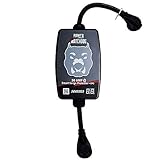
Hughes Autoformers Power Watchdog Gen I – 30 Amp Surge Protector with Emergency Power Off – Portable (PWD30-EPO)Portable EMS, 30 A, Bluetooth30 A owners who want the pedestal readings on a phone inside the RV, and a surge module they can replace instead of the whole unit30 A, 120 V, 3,600 W3-mode (L-N, L-G, N-G); 3,000 J; 6,500 A per MOV90 s power-on delay after a fault clearsLimited Lifetime (Hughes)——IP65 — dust and rain————11½ × 5½ × 3¾ in; about 31 in long with cables
Southwire Surge Guard 34950 — 50A Portable Surge Guard with Enhancement, O/U, LCD, 50A 240VPortable EMS, 50 A, LCD50 A rigs whose owners want a plain-English LCD readout and a lock ring on the cord, with a 30 A sibling (34930) for the smaller coach50 A, 120/240 V, 12,000 W (34930: 30 A, 120 V, 3,600 W)Multi-mode (L-N, L-N, L-G, N-G, L-L); 4,200 J; clamping < 300 VAC; 6,500 A per MOV (34930: 3-mode, 2,450 J)128 s reset delay to protect the A/C compressor; 10 s start-up sequence; automatic reset on power restorationLimited Lifetime plus Connected Equipment Coverage (Southwire warranty terms)Open ground, open neutral, reverse polarity, miswired pedestal, elevated ground-line currentLCD: L1/L2 voltage and amp draw (RMS), RV ON/OFF, fault messages such as OPEN GROUND, REVERSE POLARITY, L1 LOW—Anti-theft lock ring on cord———4.68 × 22.00 × 3.86 in (34930: 4.68 × 21.50 × 3.86 in)

The picks

The portable 30 A electrical management system that cuts power to the RV on low voltage, high voltage, reverse polarity, open ground, open neutral, bad frequency or an accidental 240 V pedestal — and scrolls the readings and error codes on its own display.

Best for: Any 30 A RV that moves between campgrounds — the one unit to own if you buy only one

Service
30 A, 120 V (3,600 W)
Surge protection
3-mode (L-N, L-G, N-G); 1,790 J; 44,000 A; response < 1 ns
Low voltage
Shuts off below 104 V held for 6 s (error E 4)
High voltage
Shuts off above 132 V after 3 s; above 140 V after 1 s; above 156 V within 60 ms (E 3)
Wiring faults
Reverse polarity (E 1), open ground (E 2) and open neutral: power is never applied; accidental 240 V: instant shutdown
Frequency
Shuts off below 51 Hz (E 8) or above 69 Hz (E 7)
Reconnect delay
2 min 16 s (136 s) after a fault clears, to protect the A/C compressor; 6 s start-up check on a clean pedestal
Surge-module status
E 10 when the surge protection is used up — power stays on, unit should be replaced
Display
Scrolls voltage, current, frequency, error code and previous error code every 2 s
Weather
Weather resistant (not submersible); use upright, not on the ground
Security
Built-in locking bracket for a cable lock
Warranty
Limited Lifetime (Progressive Industries)
  • A true EMS: it disconnects the RV on every pedestal fault our intro lists, not just surges — low voltage, the one that quietly kills A/C compressors, included
  • Tells you what went wrong: an error code for each fault and a 'previous error' memory, so a trip overnight isn't a mystery in the morning
  • The 136-second reconnect delay protects the air conditioner's compressor from a hard restart after a brownout
  • Plug it into the pedestal first and read it before connecting the RV — the manual's own procedure for testing a site
  • Shows an open-ground fault on a floating-neutral generator and refuses to pass power — correct behaviour, fixed with a bonding plug such as the Southwire 44400, never by bypassing the EMS
  • Does not stop a surge from killing itself: once the surge module is spent (E 10) the unit still passes power, but with no surge protection until it is replaced
  • Navico's site publishes the manual but no dimensions, weight or IP rating for the unit
  • Limited Lifetime warranty terms are stated only on the manufacturer's warranty form, not on a product page
Read the full write-up →

The 50 A, 120/240 V version of the same electrical management system: both lines monitored independently, five-mode surge protection, and the same power-cutting response to voltage, polarity, ground, neutral and frequency faults.

Best for: 50 A RVs with two air conditioners, where a dropped leg or a low leg is the common campground problem

Service
50 A, 120/240 V (12,000 W)
Surge protection
5-mode (L1-N, L2-N, N-G, L1-L2, L-G); 3,580 J; 88,000 A; response < 1 ns
Low voltage
Shuts off below 104 V held for 6 s on either line (E 4 line 1, E 6 line 2)
High voltage
Shuts off above 132 V after 3 s; above 140 V after 1 s; above 156 V within 60 ms (E 3 line 1, E 5 line 2)
Wiring faults
Reverse polarity (E 1), open ground (E 2) and open neutral: power is never applied; accidental 240 V on a 120 V line: instant shutdown
Frequency
Shuts off below 51 Hz (E 8) or above 69 Hz (E 7)
Reconnect delay
2 min 16 s (136 s) after a fault clears; 6 s start-up check
Display
Scrolls L1 and L2 voltage and current, frequency, error code and previous error code
Weather
Weather resistant (not submersible); use upright
Security
Built-in locking bracket for a cable lock
Warranty
Limited Lifetime (Progressive Industries)
  • Each 120 V leg has its own voltage, current and error codes, so a pedestal with one weak leg — the classic 50 A site fault — is caught and named
  • Five surge modes including line-to-line, which a 30 A unit never needs and a 240 V service does
  • Same conservative cut-offs and 136-second compressor delay as the 30 A unit
  • Full protection on a 30 A or 20 A site through an adapter — the manual says so, with power limited to the lower rating
  • Twice the joules of the PT30X, but a 50 A cord set and unit is heavier to carry and harder to park on a crowded pedestal
  • Same floating-neutral generator behaviour: open ground, no power, until the generator is bonded
  • No dimensions, weight or IP rating published on Navico's site
Read the full write-up →

A 30 A portable with 3,000 J of surge protection, an Emergency Power Off that cuts the RV off below 104 V or above 132 V, a replaceable surge module, and a Bluetooth app that shows volts, amps and watts on your phone.

Best for: 30 A owners who want the pedestal readings on a phone inside the RV, and a surge module they can replace instead of the whole unit

Service
30 A, 120 V, 3,600 W
Surge protection
3-mode (L-N, L-G, N-G); 3,000 J; 6,500 A per MOV
Emergency Power Off
Shuts off below 104 V or above 132 V; restores automatically once stable for 90 s
Wiring checks
Reverse polarity check; voltage-on-ground check (Hughes spec table)
Reconnect delay
90 s power-on delay after a fault clears
App
Bluetooth to Hughes's free iOS/Android app: live voltage, amperage, wattage, fault alerts; LED diagnostics on the unit
Surge module
User-replaceable; Hughes offers one free replacement module within the first two years (proof of purchase)
Weather
IP65 — dust and rain
Size
11½ × 5½ × 3¾ in; about 31 in long with cables
Warranty
Limited Lifetime (Hughes)
  • Highest joule rating of the 30 A units here, and the surge element is a plug-in module — a hit on the pedestal doesn't retire the whole protector
  • The phone app means checking park power without going outside; fault alerts arrive as notifications
  • Same 104/132 V window as the Progressive EMS, with a shorter 90 s reconnect
  • IP65 is an actual stated ingress rating, which the Progressive and Southwire portables don't publish
  • Hughes's product page and spec table name reverse-polarity and voltage-on-ground checks and the voltage cut-offs; open-neutral detection is not spelled out, so we don't claim it
  • Bluetooth only on the Gen I — monitoring from away from the RV needs Hughes's Gen II Wi-Fi version
  • Theft lock is a separate accessory (Hughes's adjustable security cable lock), not built in
  • The 90 s reconnect is shorter than the 136 s the Progressive uses for compressor protection
Read the full write-up →

Southwire's full-protection 50 A portable: 4,200 J across five surge modes, over/under-voltage shutoff, open-ground, open-neutral, reverse-polarity, high-neutral-current and overheating-plug protection, with a two-line LCD that shows volts and amps on both legs.

Best for: 50 A rigs whose owners want a plain-English LCD readout and a lock ring on the cord, with a 30 A sibling (34930) for the smaller coach

Service
50 A, 120/240 V, 12,000 W (34930: 30 A, 120 V, 3,600 W)
Surge protection
Multi-mode (L-N, L-N, L-G, N-G, L-L); 4,200 J; clamping < 300 VAC; 6,500 A per MOV (34930: 3-mode, 2,450 J)
Over/under voltage
Shuts off below 102 V or above 132 V (product page; manual table: 136 V); 7 s trip time
Wiring faults
Open ground, open neutral, reverse polarity, miswired pedestal, elevated ground-line current
Current protection
High neutral current trip at 130% (50 A model); receptacle temperature trip for an overheating plug/receptacle
Reconnect delay
128 s reset delay to protect the A/C compressor; 10 s start-up sequence; automatic reset on power restoration
Display
LCD: L1/L2 voltage and amp draw (RMS), RV ON/OFF, fault messages such as OPEN GROUND, REVERSE POLARITY, L1 LOW
Security
Anti-theft lock ring on cord
Receptacle
Commercial-grade brass; Easy-T-Pull handles
Size
4.68 × 22.00 × 3.86 in (34930: 4.68 × 21.50 × 3.86 in)
Warranty
Limited Lifetime plus Connected Equipment Coverage (Southwire warranty terms)
  • The widest documented fault list of the four: adds high-neutral-current and receptacle-overheat trips to the usual voltage, ground, neutral and polarity checks
  • Fault messages in words on the LCD — 'OPEN GROUND', 'L1 LOW WAS 99V' — with the value that caused the trip
  • Connected-equipment coverage in the warranty, with Southwire's conditions
  • Lock ring on the cord, so the unit can be cabled to the pedestal without an add-on bracket
  • Southwire's product page and brochure give the high-voltage cut-off as >132 V while the printed manual's spec table says 136 V — we show the page figure; expect the unit to behave within that range
  • The lower cut-off is 102 V, two volts below the 104 V the Progressive and Hughes units use — a touch more tolerant of brownout
  • No amazon.com listing for the 50 A unit at the time of writing; the 30 A 34930 is on Amazon
  • No IP rating or weight published
Read the full write-up →

Working out what you need before you buy? Read the generators & backup power guides.