
Skip to content

Best Indoor Air Quality Monitors: CO2 Monitors and Hygrometers

We earn a commission if you buy through links on this page, at no extra cost to you. It does not change what we recommend — see our affiliate disclosure. As an Amazon Associate I earn from qualifying purchases.

Most indoor air complaints are a ventilation or humidity problem, and both are measurable. Stale, stuffy air in an occupied room is usually carbon dioxide building up because too little outdoor air is coming in; clammy air, window condensation or static shocks are relative humidity outside the 30–50% range our guides target. A monitor replaces the guess with a number, and the number tells you whether the fix is an exhaust fan, a dehumidifier or mechanical ventilation.

The CO2 reading only means something if the sensor actually measures CO2. An NDIR (non-dispersive infrared) sensor does. Many low-cost monitors show an "eCO2" or "CO2 equivalent" figure that is estimated from a VOC sensor — it rises with cooking smells and cleaning sprays, not with how stale the air is, and it is not real CO2. Every CO2 reading on this page comes from an NDIR sensor. Outdoor air sits around 400–450 ppm; indoor levels climbing into the high hundreds or beyond while people are in the room mean air exchange is inadequate.

Particulates and radon are separate questions. Cooking produces fine particulates (PM2.5) on induction as well as on gas, and only a monitor with a particle sensor shows whether the range hood is clearing them. Radon depends on the ground under the house, not on fuel choice, and a continuous radon monitor needs days of data before its reading settles — judge it on the long-term average.

None of these monitors detects carbon monoxide. A CO alarm is a separate, listed safety device, and every home with a fuel-burning appliance, an attached garage or a generator needs one regardless of what an air quality monitor shows.

How we picked

  • CO2 measured by an NDIR sensor, never estimated (eCO2) from a VOC sensor
  • Manufacturer-stated accuracy for each reading we rely on
  • Readable on the device itself, with history you can review over days or a season
  • No subscription needed to see your own data
  • Honest about what it does not measure — none of these replaces a CO alarm

We do not accept payment for placement and we do not publish star ratings we did not measure. Specifications come from each manufacturer's published spec sheet.

Side by side

ProductTypeBest forMeasuresDisplayPowerConnectivityWarrantyCO₂ sensorSubscription
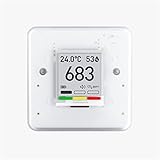
Aranet Aranet4 HOMECO2 monitor (NDIR)Finding out whether a stuffy room is short of fresh airCO₂, temperature, relative humidity, barometric pressure (pressure in the app only)E-ink with colour status (defaults: green under 1,000 ppm, amber 1,000–1,400, red above 1,400)2 × AA (included); Aranet rates 2.8 years at 5-minute readings with Bluetooth on (alkaline)Bluetooth to the free Aranet Home app; stores 30 days on the device at 10-minute readings2 years (extendable to 3 with registration)NDIR (non-dispersive infrared) — measured CO₂, not an estimateNone
Govee Bluetooth Hygrometer Thermometer H5075HygrometerKnowing your real indoor humidity, and tracking it across a seasonRelative humidity and temperatureLCD2 × AAA (Govee states about 6 months)Bluetooth only (no Wi-Fi), Govee Home app12 months—None
Airthings View Plus (2960)Multi-sensor monitor (radon, PM2.5, CO2)One monitor for cooking particulates, CO₂, humidity and radon togetherRadon, PM2.5, CO₂, total VOCs, humidity, temperature, air pressure2.9 in e-paper with red/yellow/green glow indicator6 × AA (up to 2 years, depending on router and interval) or USB-C2.4 GHz Wi-Fi and Bluetooth LE; free Airthings app required for setup1 year (North America); free 5-year extension when registered within 30 daysNDIR, 400–5,000 ppm; ±50 ppm ±3% (50–95 °F, 0–80% RH, after ~7-day initial calibration)—

The picks

A battery-powered CO₂ monitor with a true NDIR sensor and an e-ink screen that also shows temperature and relative humidity, with history synced to a phone over Bluetooth.

Best for: Finding out whether a stuffy room is short of fresh air

Measures
CO₂, temperature, relative humidity, barometric pressure (pressure in the app only)
CO₂ sensor
NDIR (non-dispersive infrared) — measured CO₂, not an estimate
CO₂ range / accuracy
0–9,999 ppm; ±(30 ppm + 3% of reading), specified for 0–5,000 ppm at 59–95 °F
Humidity
0–85% RH, ±3%
Temperature
32–122 °F, ±0.5 °F
Display
E-ink with colour status (defaults: green under 1,000 ppm, amber 1,000–1,400, red above 1,400)
Power
2 × AA (included); Aranet rates 2.8 years at 5-minute readings with Bluetooth on (alkaline)
Connectivity
Bluetooth to the free Aranet Home app; stores 30 days on the device at 10-minute readings
Calibration
Factory-calibrated; automatic background calibration or manual fresh-air calibration
Subscription
None
Warranty
2 years (extendable to 3 with registration)
  • Real NDIR CO₂ sensor — the number reflects the air in the room, not a guess derived from other gases
  • Readable on the device itself, no app needed for the live reading, and the colour status makes a closed bedroom's overnight climb obvious
  • Runs for years on two AA cells, so it can sit in a bedroom or move room to room without a cord
  • Bluetooth only — no Wi-Fi of its own, so history syncs when a phone is nearby
  • Auto-calibration assumes the sensor periodically sees fresh outdoor-level air; Aranet recommends occasional exposure to outdoor air
  • No particulate, VOC or radon sensor, and it does not detect carbon monoxide — a CO alarm is a separate device
Read the full write-up →

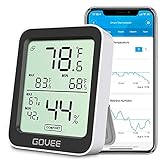
A small battery hygrometer and thermometer with an LCD screen that logs readings to the Govee Home app over Bluetooth, with out-of-range alerts and CSV export.

Best for: Knowing your real indoor humidity, and tracking it across a season

Measures
Relative humidity and temperature
Accuracy
±3% RH; ±0.5 °F (±0.32 °C)
Display
LCD
Connectivity
Bluetooth only (no Wi-Fi), Govee Home app
Data
Records viewable in the app and exportable to CSV
Alerts
App alerts when temperature or humidity leaves a preset range
Power
2 × AAA (Govee states about 6 months)
Subscription
None
Warranty
12 months
  • Answers the one question the HRV-vs-ERV choice turns on — does this house run humid or dry in winter — with a log rather than a glance
  • Readable without the app; the app adds history, alerts and a CSV you can keep
  • Small enough to put one in the basement, one in a bedroom and one by the bathroom
  • Humidity and temperature only — it says nothing about CO₂, particulates or carbon monoxide
  • Bluetooth only, so readings sync when a phone is in range
  • AAA batteries need replacing far more often than the e-ink monitors' AAs
Read the full write-up →

A seven-sensor indoor air quality monitor — radon, PM2.5, NDIR CO₂, VOCs, humidity, temperature and air pressure — with an e-paper display and Wi-Fi reporting to the Airthings app.

Best for: One monitor for cooking particulates, CO₂, humidity and radon together

Measures
Radon, PM2.5, CO₂, total VOCs, humidity, temperature, air pressure
CO₂ sensor
NDIR, 400–5,000 ppm; ±50 ppm ±3% (50–95 °F, 0–80% RH, after ~7-day initial calibration)
PM2.5 sensor
Laser-scattering optical particle counter, 0–1,000 µg/m³; ±(5 µg/m³ + 15%) below 150 µg/m³
Radon
Passive diffusion chamber, alpha spectrometry, 0–500 pCi/L; ~10% after 7 days, ~5% after 2 months (at 5.4 pCi/L)
VOCs
Total VOCs in ppb (~7-day initial calibration)
Sampling
Every 5 minutes
Display
2.9 in e-paper with red/yellow/green glow indicator
Power
6 × AA (up to 2 years, depending on router and interval) or USB-C
Connectivity
2.4 GHz Wi-Fi and Bluetooth LE; free Airthings app required for setup
Warranty
1 year (North America); free 5-year extension when registered within 30 days
  • Measures PM2.5 with a laser particle counter, so a seared steak or a wildfire-smoke day shows up as a real particulate number
  • NDIR CO₂ — measured, not estimated — alongside humidity in the same reading
  • Continuous radon monitoring, which no CO₂ monitor or hygrometer offers
  • Radon and CO₂ need days before the readings settle — Airthings quotes radon accuracy after 7 days and a ~7-day initial calibration for CO₂ and VOCs
  • The VOC figure is a total for a mix of chemicals, not a measurement of any specific one
  • Does not detect carbon monoxide or nitrogen dioxide — a gas range still needs a CO alarm, and the monitor is no substitute for one
  • Not for bathrooms: Airthings says spaces above 85% humidity can permanently damage the radon sensor
Read the full write-up →

Working out what you need before you buy? Read the heating, cooling & water heating guides.