Skip to content

Best EV Charging Accessories

We earn a commission if you buy through links on this page, at no extra cost to you. It does not change what we recommend — see our affiliate disclosure. As an Amazon Associate I earn from qualifying purchases.

Most EV-charging problems aren't charger problems — they're installation problems. The panel has no spare capacity. The only 240 V outlet already feeds the dryer. The household's charger speaks J1772 and the new car speaks NACS. Each has a purpose-built, code-recognized fix that costs a fraction of the electrician-heavy alternative.

The devices here divide into three jobs: splitters that share an existing 240 V outlet with automatic priority switching, energy-management systems that let a full charging circuit ride on a maxed-out service under NEC 625.42, and certified adapters that bridge the J1772/NACS connector transition in either direction.

Everything listed is UL or equivalent NRTL certified — this is a category flooded with uncertified lookalikes, and on 240 V continuous loads the certification is the product.

How we picked

  • UL / cETLus / UL 2251 certification — non-negotiable at 240 V continuous
  • Automatic switching or shedding, so compliance doesn't depend on habit
  • Ratings that match real circuits (24 A on 30 A, 40 A on 50 A)
  • A manufacturer that answers support email

We do not accept payment for placement and we do not publish star ratings we did not measure. Specifications come from each manufacturer's published spec sheet.

Side by side

ProductTypeBest forListing
NeoCharge Smart Splitter (NEMA 14-50)Outlet splitterSharing one existing 14-50 outlet on a 50 A circuit without new wiringUL listed; indoor use
RVE DCC-10 (Thermolec)Load management (EVEMS)Adding 240 V charging when the load calculation says noCSA and UL listed
Lectron J1772 to Tesla (NACS) AdapterCharging adapterTesla drivers using J1772 home and public chargers—
Lectron Tesla (NACS) to J1772 AdapterCharging adapterNon-Tesla EVs using Tesla wall and destination chargers—
Splitvolt Splitter Switch (NEMA 10-30 / 14-30)Outlet splitterSharing a 30 A dryer outlet with metered, breaker-protected switchingcETLus (Intertek), UL 60730-1 standard; indoor
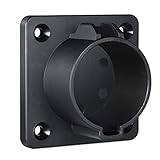
Lectron J1772 Nozzle Holster DockCable managementFinishing any charger install properly—

The picks

A UL-listed smart splitter that shares one existing 240 V outlet between two loads — two EV chargers on the 14-50 version — switching automatically so the circuit is never overloaded.

Best for: Sharing one existing 14-50 outlet on a 50 A circuit without new wiring

Output
40 A / 9.6 kW, one outlet at a time, on a 50 A circuit (14-50)
Variants
NEMA 14-50 (two EV outlets); 30 A dryer versions (24 A output)
Switching
Automatic — one outlet draws at a time
Dual-EV mode
Primary charges fully, then secondary
Smart
Wi-Fi + app, kWh tracking, scheduling
Listing
UL listed; indoor use
Origin
Made in USA
Warranty
1 year (extendable to 3)
  • Shares an existing 14-50 outlet on a 50 A breaker between two EVs with zero panel work
  • UL listing — the spec that separates it from the no-name splitter listings
  • Automatic switching means nobody re-plugs anything, ever
  • Indoor rated only
  • The outlet must be on a 50 A breaker for 40 A charging — a 40 A range circuit is not enough
  • For EV use, only the 4-wire 14-30 dryer version — a 3-wire 10-30 outlet has no equipment ground, and an EV charger may not use the neutral as one
Read the full write-up →

The code-recognized way to add a full EV circuit to a maxed-out panel: whole-home CTs shed the charger above 80% of service capacity, so the load calculation can use the managed limit instead of the charger's full rating.

Best for: Adding 240 V charging when the load calculation says no

Service
Panels up to 200 A
EV breaker
Built in — 30 / 40 / 50 / 60 A models
Operation
Sheds EVSE above 80% of main capacity; restores after 15 min below
Code basis
NEC 625.42(A) energy management (750.30); load per 220.70
Enclosure
NEMA 1 indoor (outdoor NEMA 3R model sold separately)
Listing
CSA and UL listed
  • Solves the 100-amp-panel problem for roughly a tenth of a service upgrade's cost
  • Fully automatic and invisible in daily life — shedding only happens at genuine peak
  • Works with any brand of EVSE downstream
  • Electrician install — this is panel work, not an accessory you plug in
  • During a shed event the car simply pauses; if you charge at peak hours daily, size the service honestly instead
Read the full write-up →

Lets a Tesla or NACS-port EV charge from any J1772 Level 1 or Level 2 charger — rated to 80 A / 240 V AC.

Best for: Tesla drivers using J1772 home and public chargers

Rating
Up to 80 A, 240 V AC
Direction
J1772 charger → NACS/Tesla vehicle
Sealing
IP67, -22°F to 122°F
Certification
UL 2251, TÜV
Limit
AC charging only
  • Covers every J1772 wall unit and public Level 2 station at full home-charging amperage
  • IP67 and a real UL 2251 certification at a commodity price
  • AC only — irrelevant at DC fast chargers
  • Warranty term not published on the product page — confirm at purchase
Read the full write-up →

The reverse direction: lets a J1772-port EV charge from a Tesla Wall Connector, Destination Charger or Mobile Connector — up to 48 A.

Best for: Non-Tesla EVs using Tesla wall and destination chargers

Rating
Max 48 A, 240 V (11.5 kW)
Direction
Tesla/NACS charger → J1772 vehicle
Works with
Wall Connector, Destination Chargers, Mobile Connector
Excluded
Not compatible with Superchargers
Certification
SGS certified to UL 2251
  • Unlocks the enormous installed base of Tesla wall and destination hardware for J1772 cars
  • 48 A ceiling covers every home install
  • Lectron warns that some older Tesla Destination Chargers may not complete the handshake — test before relying on one
  • Explicitly does not work at Superchargers — that's the car's DC port and pins, not this adapter
  • Warranty term not published — confirm at purchase
Read the full write-up →

A dryer-outlet splitter with automatic switching, live power metering and a built-in 24 A breaker — the 30-amp-circuit alternative.

Best for: Sharing a 30 A dryer outlet with metered, breaker-protected switching

Output
24 A @ 240 V
Variants
10-30 and 14-30 inputs; 14-50 output versions (EV use: 14-30 input only)
Switching
Automatic between dryer and EV sockets
Display
Live voltage, current and kWh
Protection
Integrated 24 A breaker with reset
Listing
cETLus (Intertek), UL 60730-1 standard; indoor
Warranty
1 year (4-year extension sold)
  • On-device power metering the NeoCharge lacks — you watch the actual draw
  • Built-in breaker adds a protection layer on aging dryer circuits
  • 24 A ceiling — about 5.7 kW, overnight-charging territory
  • Use the 4-wire 14-30 input version for EV charging — a 3-wire 10-30 dryer outlet has no equipment ground
Read the full write-up →

A wall dock the J1772 connector clicks into, keeping the nozzle off the floor and the cable coiled.

Best for: Finishing any charger install properly

Fits
All J1772 connectors (NACS version sold separately)
Material
High-quality plastic
Mounting
Screws + plugs included, indoor/outdoor
  • Ends the connector-on-the-floor habit that kills charge ports and connectors
  • Costs less than any repair it prevents
  • Plastic body; the NACS version is sold separately
Read the full write-up →

Working out what you need before you buy? Read the ev charging guides.