
How to Charge a Generator Battery: Portable and Standby
Updated 2026-10-10 · 7 min read
Gear this guide recommends
We earn a commission if you buy through links on this page, at no extra cost to you. It does not change what we recommend — see our affiliate disclosure. As an Amazon Associate I earn from qualifying purchases.
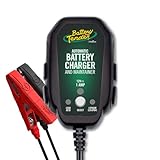
Small-battery maintainer
Battery Tender Junior Multi-Chemistry 12V (022-0199-DL-WH)
Best for: Small 12 V starting batteries, such as a generator's, that sit between uses

Smart charger / maintainer
NOCO GENIUS5
Best for: Keeping a car-sized 12 V battery charged during storage, whatever its chemistry
Jump to a section▾
Electric start is the one feature on a generator that quietly stops working while the generator sits in the garage. The engine is fine, the fuel is fine, and the starter clicks because a small 12 V battery self-discharged over the summer.
Short answer: charge it with a 12 V smart charger or maintainer at 1 to 2 amps. Charger unplugged, red clamp or ring terminal to the positive post, black to negative, then power the charger on. Leave a maintainer connected between uses. Most portable generators only charge their battery while the engine runs, and standby generators charge theirs from utility power, so a unit that sits for months is a unit with a flat battery.
What battery a generator uses
| Generator type | Typical battery | Who charges it |
|---|---|---|
| Electric-start portable | Small 12 V sealed lead-acid or AGM, roughly 7 to 20 Ah | Engine charging circuit while running; you, with a maintainer, the rest of the time |
| Home standby (Generac, Kohler, Briggs) | 12 V automotive group size | Built-in charger in the controller, on utility power |
| Recoil-start portable, most inverters under 3,000 W | None | Nothing to charge |
The portable figures are typical, not universal. Champion's manual for its 9,000 W electric-start portable, for example, lists a 12 V 15 Ah battery. Generac specifies a Group 26R automotive battery for its air-cooled standby units. Your manual's specifications page has the one that matters.
Most inverter generators under about 3,000 W are recoil-start with no battery, so this guide doesn't apply to them.
Why a portable doesn't keep its own battery charged
A portable generator has a small charging circuit, but it only works while the engine is running. Champion's manual puts it plainly: the battery "will receive charging voltage when the engine is running," it stays charged if the unit runs about once every two weeks, and if it's used less than that, it "should be connected to a trickle charger or battery maintainer." The same manual recommends fully charging the battery at least once a month regardless.
Then there's the drain. On remote-start units, the receiver that listens for the key fob draws current from the battery all the time. Champion's manual warns that an ignition switch left in the ON position for several weeks can drain the battery completely, and that even with the ignition off the receiver draws about 2 mA. Its fix is a battery switch on the panel: turn it OFF when the generator is parked.
So the normal life of a portable generator battery is: a few hours of charging during an outage, then months of self-discharge plus a trickle of parasitic draw, often in a cold garage. Lead-acid batteries lose capacity faster when stored partly discharged, which is why a battery that's "only two years old" won't crank. Some makers help: Westinghouse ships a battery float charger with its electric-start iGen12000DFc. Treat the charger as part of the generator.
How to charge it with a smart charger
Use a 12 V automatic charger or maintainer with a lead-acid or AGM mode. Champion's manuals say the maximum charging rate "should not exceed 1.5 amps" on its electric-start portables, and that's good guidance for any battery this small: a 10 A automotive charger on a 15 Ah battery will overheat it. A dedicated maintainer sized for small batteries is the right tool, and it can stay connected.
We earn a commission if you buy through links on this page, at no extra cost to you. It does not change what we recommend — see our affiliate disclosure. As an Amazon Associate I earn from qualifying purchases.
The sequence, with the generator off and the key out:
- Find the battery and its posts. On many portables it sits behind a cover near the control panel. Note the chemistry on the label: sealed lead-acid (SLA) and AGM take the same lead-acid charge profile.
- Charger unplugged. Connect the red lead to positive (+) first, then the black lead to negative (−). A set of ring terminals left on the posts makes future connections a plug-in job.
- Set the charger to 12 V and the lead-acid or AGM mode. Don't use a repair or desulfation mode on a battery that's still wired to the generator.
- Plug the charger in. It charges, then drops to a float or maintenance voltage on its own.
- To disconnect: unplug the charger, then remove black, then red.
If the generator sits for months, leave the maintainer connected. If you'd rather not, Champion's storage instructions are to disconnect the negative lead first, then the positive, and store the battery in a cool, dry place, charging it monthly.
For a standby unit's larger automotive battery, or if you want one charger for the car and the generator, a 5 A charger with an AGM mode covers both.
Standby generators charge from the grid
A home standby generator has a battery charger built into its control panel. Generac's support documentation describes an integrated 12 V charger fed by a 120 V charging circuit from the automatic transfer switch, and it describes the charge voltage as temperature-compensated, roughly 13.5 to 14.6 V depending on how hot or cold it is. During an outage, Generac says the battery charges only while the generator is running under load with the transfer switch in the generator position.
Two things follow from that:
- The charger needs utility power. If the circuit feeding the charger is off, which can happen after panel work or a tripped breaker, the battery drifts down while the controller keeps drawing from it. A low-battery warning on the controller is worth chasing immediately.
- The weekly exercise run isn't what charges it. It's the charger, on utility power, between runs. Exercise mode exists to prove the unit starts and to keep the engine healthy. See generator exercise mode.
Standby makers call for the battery to be checked at annual service and replaced on a schedule rather than when it fails. The whole point of the unit is starting unattended.
How to test a generator battery
A multimeter on DC volts across the posts, with no charger connected and the battery rested for a few hours, tells you most of what you need:
| Resting voltage (12 V lead-acid, room temperature) | State |
|---|---|
| About 12.6 V or higher | Full |
| About 12.4 V | Roughly three-quarters |
| About 12.2 V | Roughly half |
| 12.0 V or below | Discharged. Charge before use |
| Below about 10.5 V | Deeply discharged. May not recover |
These are rules of thumb for lead-acid batteries, not a maker's spec. A reading taken minutes after charging runs high and means little; let it rest.
Voltage alone can mislead. A worn-out battery can read 12.6 V and still collapse under load. The practical load test is the starter itself: if a battery that reads full after a proper charge still gives a slow crank or a click, it's done. Auto parts stores will load-test a small battery for free. Before blaming the battery, though, check that the battery switch is ON and the terminals are clean and tight.
Jump-starting and the recoil backup
Recoil first. Almost every electric-start portable also has a pull cord, and that's the right answer when the battery is flat during an outage. Champion's manual says exactly that: if the battery can't start the engine, start it with the recoil cord, and the running engine will charge the battery. It also warns that a battery that's "extremely low" may be beyond what the engine's charging circuit can recover, and needs an automotive-style charger before it will take a charge again.
Jump-starting from a car is a maker-by-maker question. Both are 12 V systems, so electrically it's possible, but the generator's control module and starter are small, and reversed polarity or a voltage spike from a running car can destroy them. If your manual describes a jump-start procedure, follow it. If it doesn't, charge the battery or use the recoil instead. A jump pack for 12 V lead-acid batteries is gentler than a car because it isn't backed by an alternator, but the same polarity rule applies.
Standby units can't be recoil-started. With a dead battery the options are a charger or a jump from a 12 V source following the maker's instructions, usually with the controller set to OFF first.
When to replace it
- It won't hold a charge. Charged fully, rested overnight, reads below about 12.4 V: the battery is sulfated or has a weak cell.
- It cranks slowly after a full charge in mild weather.
- It's swollen, leaking, or the terminals are badly corroded.
- Age. Small sealed batteries that live in a shed typically last a few years, less if they've been left flat.
Replace like for like: the same voltage, a similar Ah rating, the same post type and orientation, and a battery that fits the tray. For a standby unit, use the group size on the spec sheet.
Lithium replacements exist for small 12 V starting batteries, but fit one only if the generator maker approves it. The charging circuit in a portable and the charger in a standby controller are designed for lead-acid voltages, and a lithium battery needs a matching charge profile and its own battery management system. Where the maker allows it, use a maintainer with a lithium mode, never a lead-acid float.
Safety while you work
- Outdoors, engine off, key out before touching the battery. If you need to run the engine to test, it goes outside, at least 20 feet from doors and windows, exhaust pointed away. See carbon monoxide safety.
- No sparks near the battery. Charging lead-acid batteries releases hydrogen. Connect the charger leads before powering the charger, and disconnect them after.
- Don't let a tool bridge the posts. A wrench across a 12 V battery's terminals glows red hot.
- Polarity, every time. Red to +, black to −. The control electronics on a remote-start generator are the first casualty of a reversed clamp.
Standards and references
- Champion Power Equipment owner's manual, model 100163 (9,000 W electric-start portable): battery charging circuit, 1.5 A maximum charge rate, monthly charging, recoil backup, battery switch and remote-receiver draw, storage
- Generac support article "How is my home standby generator battery charged?": integrated 12 V charger fed from the transfer switch, temperature-compensated charge voltage, charging during an outage
- Westinghouse iGen12000DFc product page: battery float charger supplied with the generator
- ANSI/PGMA G300: portable generator safety, including CO shutoff
- CPSC portable generator guidance: outdoors only, 20 feet from the home, exhaust away from openings
Manufacturer instructions govern wherever they are more specific than this guide.
Where to go next
- Generator won't start: troubleshooting in order
- Generator maintenance schedule
- Generator exercise mode
- Gasoline storage and stabilizer
- Size it properly: generator sizing calculator
More in our generator and backup power guides.
Frequently asked questions
Ask AI about this
Open an AI assistant with a question grounded in this page.