
Whole-House vs Essential-Circuits Backup
Updated 2026-08-16 · 7 min read
Gear this guide recommends
We earn a commission if you buy through links on this page, at no extra cost to you. It does not change what we recommend — see our affiliate disclosure. As an Amazon Associate I earn from qualifying purchases.
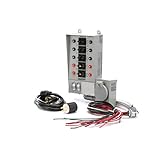
Manual transfer switch kit
Reliance Controls Pro/Tran 10-Circuit Transfer Switch Kit (31410CRK / 310CRK)
Best for: Portable generators up to 7,500 running watts with an L14-30 outlet

Mid-size inverter (3,000–6,000 W running)
Honda EU7000iS
Best for: Quiet, transfer-switch-ready 240 V backup for essentials when reliability matters more than watts per dollar
Jump to a section▾
"Whole-house generator" is a marketing category more than a technical one. Understanding what it actually delivers changes what you buy.
What does "whole house" usually mean?
Most systems sold as whole-house feed the entire panel but include automatic load management that sheds lower-priority circuits when demand approaches capacity.
So the house behaves normally — until you try to run the air conditioner and the electric water heater and the range simultaneously, at which point the controller drops one.
In practice you rarely notice. And that's the point: load shedding lets a smaller generator serve a larger house, which is far cheaper than sizing for genuine simultaneous peak.
True unmanaged whole-house capacity — everything, at once, without shedding — requires a substantially larger generator and is uncommon in residential installations.
What determines the size
Not square footage. Specific loads:
| Load | Approximate demand |
|---|---|
| Electric range | 8–12 kW |
| Electric dryer | 5 kW |
| Electric water heater | 4.5 kW |
| Central AC (3 ton) | 3–3.5 kW running, much higher starting |
| Heat pump + electric backup heat | 10–20 kW |
| Well pump | 1–2 kW running, high starting |
| Everything else | 2–4 kW |
An all-electric home with a heat pump and electric strip backup is a very different problem from a gas-heated home with gas cooking and water heating. The second may need less than half the generator for equivalent comfort.
This is why the honest first step is a load calculation, not a catalogue. See what can a generator run and the generator sizing calculator.
Essential circuits
The alternative: a transfer switch feeding a subpanel of selected circuits — typically 6 to 12.
What people usually select:
- Furnace or boiler
- Refrigerator and freezer
- Sump pump
- Well pump
- Some lighting
- A few receptacle circuits
- Internet equipment
- Garage door opener
What gets left out:
- Electric water heater
- Electric range
- Electric dryer
- Air conditioning
- Electric resistance heat
What that feels like: the house is warm, the food is cold, the water runs, the lights work, and phones charge. You shower with whatever hot water the tank holds, cook on the grill or a camp stove, and don't run laundry.
For a few days, that's tolerable — and it's a fraction of the cost.
How do you choose which circuits go on the subpanel?
The selection is the whole design, and it's worth doing carefully rather than letting the installer guess.
The method:
- Get an accurate circuit directory first. You cannot select circuits you can't identify — see how to find which breaker controls an outlet.
- Rank by consequence, not convenience. What causes damage if it stops (sump pump, furnace, well pump) beats what causes discomfort.
- Count the spaces. A transfer subpanel has a fixed number of positions, and 240-volt loads take two each.
- Add up the running and starting watts of everything selected, then check the largest single surge against the generator.
Three traps that catch people at this stage:
- A wanted load and an unwanted load on the same circuit. The kitchen receptacle circuit you want for the coffee maker may also feed something you'd rather not carry. You can't split a circuit at the transfer switch — it moves as a whole, or it doesn't move.
- Multi-wire branch circuits. Two circuits sharing a neutral must stay on opposite legs of the same source. Moving one leg to the transfer subpanel and leaving the other behind overloads the shared neutral. Both legs move together, or neither does — see what is a multi-wire branch circuit.
- The load's accessories. A condensing furnace may have its condensate pump plugged into a different circuit; a well system may have a separate control box. Powering the equipment without its accessories means it still won't run.
Leave a couple of spare positions. The list you write today isn't the list you'll want after your first real outage.
Does the generator have to match the service size?
No — and believing it does is what pushes people toward far larger units than they need.
For residential backup, the NEC treats this as an optional standby system under Article 702. The requirement is that the source has adequate capacity for the load it actually serves, calculated per Article 220. Where automatic load management is used to prevent the generator being overloaded, the alternate source can be sized for the managed load rather than for the full service.
That's the code basis for everything on this page: a 200-amp service does not require a generator capable of 200 amps. It requires a generator capable of what you've arranged for it to carry.
Two practical notes on the switchgear:
- A service-rated transfer switch installs ahead of the main panel and feeds the whole house; a non-service-rated one installs downstream. Which you need depends on the design, and it affects both cost and where things physically go.
- Recent code cycles also require an emergency disconnect at dwellings, which interacts with where the transfer equipment sits. Your electrician will handle it, but it's a reason the "just add a transfer switch" job sometimes involves more than expected.
Can you start small and upgrade later?
Yes, and it's an underrated path — particularly when you're not yet sure how often you'll actually need it.
A sensible sequence:
- Interlock kit and inlet box, with a portable generator. Gives you access to every circuit in the panel, manually managed. Lowest cost by a wide margin.
- Live through an outage or two. You'll learn what you actually reach for, which is rarely what you predicted.
- Upgrade to a standby unit if the frequency justifies it.
What carries forward: the inlet box and its wiring often remain useful, the circuit knowledge is permanent, and the sizing decision at step 3 is now based on measured experience rather than a catalogue.
What doesn't carry forward: an interlock is not a transfer switch, so the switchgear generally gets replaced. That's a modest write-off against making a much better-informed decision on the expensive part.
The cost gap
The gap isn't only the generator:
Essential circuits: a portable or small standby unit, a subpanel transfer switch, a modest fuel supply.
Whole house: a large standby unit, a service-rated transfer switch with load management, a substantial gas line or a large propane tank, a bigger pad, and often utility meter work.
The fuel supply is a frequently underestimated part of this — a large standby generator may need a meter upsize or a several-hundred-gallon propane tank. See natural gas vs propane generator and standby generator installation cost.
The middle path
Two approaches worth knowing, because they're often the right answer:
Whole panel with manual load management. A breaker interlock gives you access to every circuit; you switch off what you don't want. Cheapest option, and the flexibility is real — priorities in a summer outage differ from a winter one. The cost is that you manage it. See generator interlock kit vs transfer switch.
Essentials plus one luxury. Size for the essential list plus air conditioning or the water heater, with load shedding ensuring they never coincide. Much cheaper than sizing for both, and it removes the main discomfort of essential-circuits coverage.
Reducing what you need
Before sizing up, consider reducing demand:
A soft starter on the air conditioner cuts inrush substantially, often bringing central AC within reach of a much smaller generator. Frequently cheaper than the generator upgrade.
Accept intermittent operation for deferrable loads — run the water heater for an hour, then switch back.
A battery for the quiet loads. A power station covering electronics, networking, and medical equipment means the generator only runs for the heavy stuff, which cuts fuel and noise. See battery backup vs generator.
Choosing
Essential circuits, if: outages are occasional, you're willing to defer cooking and hot water, budget matters, or a portable generator is what you have.
Whole house with load management, if: outages are frequent or long, you want the house to feel normal, you're away often enough that automatic operation matters, or medical equipment is involved.
True unmanaged whole-house: rarely worth it. Load shedding costs almost nothing in experience and saves a great deal in capacity.
Where to go next
More in our generator and backup power guides.
Frequently asked questions
Ask AI about this
Open an AI assistant with a question grounded in this page.