
Transfer Switch Explained
Updated 2026-08-16 · 6 min read
Gear this guide recommends
We earn a commission if you buy through links on this page, at no extra cost to you. It does not change what we recommend — see our affiliate disclosure. As an Amazon Associate I earn from qualifying purchases.
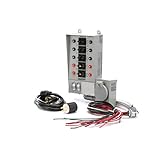
Manual transfer switch kit
Reliance Controls Pro/Tran 10-Circuit Transfer Switch Kit (31410CRK / 310CRK)
Best for: Portable generators up to 7,500 running watts with an L14-30 outlet
Jump to a section▾
A transfer switch exists to enforce one rule: the utility and the generator are never connected at the same time.
Everything else — automatic starting, load shedding, circuit selection — is built on top of that single function.
Transfer switch types
| Type | Operation | Typical use |
|---|---|---|
| Manual, circuit-select | You flip each circuit to generator | Portable generator, essential circuits |
| Manual, service-rated | Switches the whole panel | Portable feeding everything |
| Automatic (ATS) | Senses loss, starts, switches, switches back | Standby generator |
| Interlock kit | Not a switch — a mechanical lockout on the panel | Cheapest compliant option |
Whatever the type, the job is the same and it is non-negotiable: the house must never be connected to the generator and the utility at once. That separation is what protects lineworkers and what stops the generator being destroyed when utility power returns.
Why does the rule matter?
Two directions of harm:
Toward the utility. Your panel connects to a transformer that steps voltage up on the way out. A generator feeding the panel while the utility is connected energizes the distribution line at thousands of volts, on conductors crews may be handling as dead. See backfeeding dangers.
Toward your generator. When utility power returns, it arrives out of phase with your generator. Connecting the two destroys the generator, and does so violently.
Break-before-make
The mechanism that enforces the rule.
A transfer switch physically opens the utility connection before it closes the generator connection. There is no position in which both are connected — not briefly, not during the transition.
This is mechanical, not electronic. The switch cannot be in both positions any more than a light switch can be up and down at once.
That's the whole safety argument, and it's why a transfer switch or a listed interlock is required rather than a procedure someone follows carefully.
Manual vs automatic
Manual transfer switch. You start the generator, walk to the switch, and move it to the generator position. Cheaper, simpler, fewer components to fail. Requires someone present and awake.
Automatic transfer switch (ATS). Senses the outage, signals a standby generator to start, waits for it to stabilize, then transfers. Reverses the sequence when utility power returns and runs a cooldown before shutting down.
Automatic is the point of a standby system — it covers outages when you're away, asleep, or unable. It's also required for the whole proposition of a standby generator to work.
See manual vs automatic transfer switch.
Whole-service vs subpanel
Service-rated transfer switch. Rated to serve as the service disconnect, installed between the meter and the main panel. It transfers the entire service, so every circuit in the house is available — subject to generator capacity, which is where load shedding comes in.
Non-service-rated / subpanel switch. Feeds a separate subpanel containing selected circuits — typically 6, 8, 10, or 12 of them. You decide in advance what matters: furnace, refrigerator, well pump, sump pump, some lighting and outlets.
Subpanel switches are the common pairing with portable generators. They're cheaper, they force useful prioritization, and they naturally limit demand to what the generator can carry.
For a portable generator, one kit covers it — switch, outdoor inlet box and generator cord in one box:
We earn a commission if you buy through links on this page, at no extra cost to you. It does not change what we recommend — see our affiliate disclosure. As an Amazon Associate I earn from qualifying purchases.
Load shedding
The feature that lets a smaller generator serve a larger house.
A load-shedding controller monitors total demand and disconnects lower-priority circuits when it approaches the generator's capacity — usually air conditioning, an electric water heater, or an electric range.
Effect: the big loads never run simultaneously, so peak demand stays within the generator. You might have air conditioning or the water heater, but never both at once — and you barely notice.
This is often much cheaper than sizing the generator for genuine simultaneous peak. See what can a generator run.
Choosing circuits for a subpanel switch
Think about what an outage actually makes intolerable:
Almost always:
- Furnace or boiler controls and blower — heat in winter
- Refrigerator and freezer
- Sump pump, if you have a basement
- Well pump, if you have no municipal water
- Some lighting
- A few receptacle circuits for charging and small appliances
Often worth including:
- Garage door opener
- Internet equipment
- A bathroom circuit
- Medical equipment circuits — see CPAP and medical device backup
Usually excluded:
- Electric water heater, range, dryer — large and deferrable
- Air conditioning, unless the generator is sized for it
- Electric resistance heat
Count the 240-volt circuits carefully. Each takes two positions in the switch, and a well pump plus an air conditioner uses four.
Sizing the switch
The transfer switch must be rated for the service it carries — a 200 A service needs a 200 A service-rated switch — and for the generator output on the generator side.
A subpanel switch is rated by the number of circuits and the generator connection it accepts. Get both right; an undersized switch is a fire risk and won't pass inspection.
Installation
Transfer switch installation is permitted and inspected work in essentially every jurisdiction, and it involves working in an energized panel where the main lugs stay live with the main breaker off.
This is licensed electrician work. See generator permits and inspection and standby generator installation cost.
One technical point the installer must get right: neutral bonding. Whether the transfer switch switches the neutral determines whether the generator should be bonded or floating, and getting it wrong produces either a missing bond or a second one. See generator neutral bonding.
The cheaper alternative
For a portable generator, a breaker interlock kit achieves the same safety outcome — the main and generator breakers cannot both be on — for considerably less money.
The trade-off: an interlock gives you the whole panel with manual load management, where a subpanel switch gives you selected circuits with the prioritization built in. Both are legal and inspected. See generator interlock kit vs transfer switch.
Standards and code reference
The standards behind this guide, for looking up in the edition your jurisdiction has adopted:
- NEC Article 702 — optional standby systems
- NEC 702.5 — transfer equipment requirements
- UL 1008 — transfer switch equipment standard
Code editions and local amendments vary. Confirm the adopted edition with your AHJ, and treat manufacturer instructions as governing wherever they are more restrictive.
Where to go next
- Manual vs automatic transfer switch
- Generator interlock kit vs transfer switch
- How to connect a generator to your house
- Size it properly: generator sizing calculator
More in our generator and backup power guides.
Frequently asked questions
Ask AI about this
Open an AI assistant with a question grounded in this page.