
EV Charging Cable Damage and Safety
Updated 2026-08-16 · 6 min read
Gear this guide recommends
We earn a commission if you buy through links on this page, at no extra cost to you. It does not change what we recommend — see our affiliate disclosure. As an Amazon Associate I earn from qualifying purchases.
Cable management
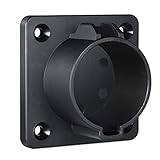
Lectron J1772 Nozzle Holster Dock
Best for: Finishing any charger install properly
Jump to a section▾
The cable is the part of an EV charging setup that fails first. It gets dragged across concrete, coiled and uncoiled thousands of times, flexed in the cold, and left in whatever weather your driveway provides. Everything else in the system is static; the cable is the moving part.
Fortunately, inspecting it takes under a minute and catches nearly everything.
Where do EV charging cables fail?
Not randomly. Four locations account for most failures:
1. At the connector handle. The highest-stress point. Every plug-in flexes the cable at the same spot, and this is where strain relief either does its job or doesn't. Inspect here first, every time.
2. At the charger's exit point. Same issue at the other end.
3. Where it's been driven over. Crushing damages conductors and insulation without necessarily showing much on the surface — which is what makes it dangerous.
4. Where it drags. Abrasion from the same stretch of concrete every day, gradually wearing the jacket.
How do you inspect an EV charging cable?
Once a month, or after any incident:
Run the whole length through your hand. You're feeling for flat spots, stiffness changes, bulges or soft areas that suggest internal damage.
Look closely at both ends, flexing gently at the strain relief. Cracks in the jacket at the handle are the most common finding.
Check the connector housing for cracks, and the latch for proper operation.
Inspect the pins. They should be clean and uniformly colored. Discoloration, pitting or corrosion means heat — a high-resistance connection that's been running hot.
Check the charge port on the car too. Pin damage is a two-sided problem, and a worn port damages good cables.
When should you stop using a charging cable?
Immediately, not at your convenience:
| Finding | Why |
|---|---|
| Any exposed conductor or inner insulation | Shock and fire risk |
| Cuts through the outer jacket | Moisture path, compromised protection |
| Crushed or flattened section | Likely internal conductor damage |
| Cracked connector housing | Moisture ingress into live parts |
| Discolored, pitted or corroded pins | Overheating connection |
| Cable warm along its length while charging | Undersized or damaged conductors |
| Burning smell | Stop now |
| Latch not engaging properly | Poor contact, arcing risk |
There is no "keep an eye on it" category here. A cable carrying 40 amps continuously in a wet outdoor environment with compromised insulation is not a monitoring situation.
Can you repair an EV charging cable?
To be explicit, because people ask:
- Tape is not a repair. Not electrical tape, not self-amalgamating tape, not anything.
- Splicing is not acceptable. EVSE cable carries high continuous current and is subject to constant flexing and weather. A field splice is a failure point.
- Heat shrink over damaged insulation doesn't restore the cable's rating.
Damaged cables get replaced. Some manufacturers sell replacement cables; others don't, which makes the whole unit the replacement. That's worth checking before you buy — see EV charger brands compared, and check whether the warranty covers the cable at all, since many exclude it.
Can you use an extension cord to charge an EV?
The most common dangerous improvisation.
EVSE cable is engineered for the job: correct conductor size for continuous high current, jacket rated for the environment, strain relief at both ends, and connectors rated for thousands of insertion cycles.
An extension cord introduces:
- Undersized conductors for continuous high-current draw
- Two additional connection points, each a resistance and heat source
- A jacket that may not be rated for the location
- No strain relief designed for the application
Manufacturers prohibit it, and it's one of the more reliable ways to start a fire. If the cable doesn't reach: buy a longer-cable charger, or relocate the unit. See EV charger cable length for measuring the routed path properly, and EV charger installation mistakes to avoid.
Habits that prevent damage
Holster the connector every time. Not on the floor, not on the ground, not dangling. This single habit prevents most connector damage — grit, water and road salt in the pins is the leading cause of degradation.
Add a wall hook for long cables. Cheap, and it's the difference between a tidy cable and one that lives on the floor.
Route it out of the vehicle's path and off the walkway.
Don't stretch it. Tension strains exactly the points that fail.
Coil loosely. Tight coils and sharp bends fatigue conductors.
Be gentle in the cold. Jackets stiffen and are more prone to cracking when flexed cold. Warm the cable by handling it before forcing a coil. See cold-weather EV charging.
Mount high enough that the cable's natural drape keeps the connector off the ground — mounting height and placement.
Public charging cables
You don't own them, but you can protect yourself and others:
- Inspect before plugging in. A damaged public cable is a real hazard, and nobody else has looked at it.
- Report damage in the network app and to the operator. This is how it gets fixed.
- Don't force a damaged connector into your port — you'll damage the port too.
- Return cables to their holsters. See EV charging etiquette.
If a cable was driven over
Take it seriously even if it looks fine. Crushing can damage conductors and internal insulation with minimal external evidence.
- Stop using it
- Inspect carefully, flexing the affected section
- If there's any flattening, stiffness change or jacket damage, replace it
- If it looks perfect and you resume use, watch closely for warmth along that section during the next several sessions
When in doubt, replace. A cable is far cheaper than the alternative.
The bottom line
Inspect near the handle first — that's where cables fail — and run the whole length through your hand monthly. Any exposed conductor, crushed section, cracked housing or discolored pin takes the cable out of service permanently; tape and splices are not repairs. Never use an extension cord. Holster the connector every single time, and the cable will outlast the car.
The habit that prevents most of this
Of the prevention list above, holstering the connector and hanging the slack does more for cable life than everything else combined — and it is the one item that needs hardware rather than discipline:
We earn a commission if you buy through links on this page, at no extra cost to you. It does not change what we recommend — see our affiliate disclosure. As an Amazon Associate I earn from qualifying purchases.
Cable management
Lectron J1772 Nozzle Holster Dock
A wall dock the J1772 connector clicks into, keeping the nozzle off the floor and the cable coiled.
Best for: Finishing any charger install properly
- Fits
- All J1772 connectors (NACS version sold separately)
- Material
- High-quality plastic
- Mounting
- Screws + plugs included, indoor/outdoor
- Ends the connector-on-the-floor habit that kills charge ports and connectors
- Costs less than any repair it prevents
- Plastic body; the NACS version is sold separately
More options are in the EV charging accessory picks.
Verify your circuit with the Level 2 charger breaker size calculator, or read EV charger maintenance.
Frequently asked questions
Ask AI about this
Open an AI assistant with a question grounded in this page.