
EV Charger Mounting Height and Placement
Updated 2026-08-16 · 6 min read
Gear this guide recommends
We earn a commission if you buy through links on this page, at no extra cost to you. It does not change what we recommend — see our affiliate disclosure. As an Amazon Associate I earn from qualifying purchases.
Cable management
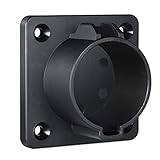
Lectron J1772 Nozzle Holster Dock
Best for: Finishing any charger install properly
Jump to a section▾
Mounting position is decided in about thirty seconds on install day and then lived with for a decade. Three things depend on it: whether the cable ever touches the floor, whether the connector reaches your port in every parking situation, and whether a car eventually hits the charger.
Placement rules of thumb
| Guidance | |
|---|---|
| Mounting height | Roughly 42–48 in to the connector holster |
| Why not lower | Standing water, snow, and road salt |
| Why not higher | Cable weight and awkward reach |
| Horizontal position | Between the bays if two cars may use it |
| Clearance from the bay | Far enough that a bumper cannot reach it, or add a bollard |
| Outdoors | Sheltered if possible; NEMA 4 enclosure regardless |
| Cable management | A hook or reel — a cable on the floor gets driven over |
Map your car's charge port corner before choosing a wall. Ports sit front-left, front-right, rear-left and rear-right depending on the manufacturer, and a charger mounted on the wrong side turns a 20 ft cable into a 25 ft requirement.
How high should an EV charger be mounted?
The controlling principle is simple. Mount high enough that the cable and connector never rest on the ground.
A cable dragging on a garage floor collects grit, water and road salt, which end up in the connector pins. Outdoors it's worse — standing water and de-icing salt are hard on contacts. A connector that sits in a puddle every night will show it.
In practice that means roughly chest height for most garages: high enough that the natural cable drape stays clear of the floor, low enough that lifting and plugging the connector is comfortable.
Two constraints on top of that:
- The manufacturer's installation instructions. Listed equipment must be installed per its listing, and some units specify a mounting height range or an orientation. That document governs.
- Who uses it. If someone in the household has limited reach or uses a wheelchair, mount lower and make sure there's clear approach space. High-amperage cables are heavy; ergonomics matter more than they seem.
Where should an EV charger be mounted?
Charge ports are not standardized. Depending on the vehicle they sit on the driver-side rear quarter, the passenger-side rear quarter, either front fender, or the nose.
Before choosing a wall position:
- Park the car exactly where it normally sits
- Note the port location
- Trace the routed path — down from the mounting point, along the floor, around the vehicle to the port
- Repeat if you sometimes back in
- Repeat for a second vehicle or a second bay
Take the longest result. That's your cable requirement, and it interacts directly with where you mount. EV charger cable length covers the measuring method; the EV model reference confirms port locations.
A useful rule for two-bay garages: mount centrally between the bays rather than at one end. A central position with a moderate cable often serves both spots better than an end position with a very long one.
The panel-distance tradeoff
Here's a decision worth making deliberately: mounting the charger closer to the electrical panel shortens the circuit run, which is the expensive part of the install. Mounting it closer to the car shortens the cable, which is cheap.
Longer charging cable is almost always cheaper than a longer circuit. If your panel is on the opposite wall from where you park, seriously consider mounting near the panel and buying more cable. EV charger conduit and wire runs covers what run length actually costs.
How do you protect an EV charger from being hit?
If the charger is anywhere a vehicle could contact it — the end wall of a bay, a driveway post, an open parking area — it needs physical protection. A bollard is the standard answer, and inspectors commonly look for one where impact is plausible.
The cheaper solution is placement: mount on a side wall, out of the vehicle's travel path, and the question doesn't arise. This is one of the better reasons to plan the position before install day rather than during.
Clearances
Two kinds:
Manufacturer clearances. Units specify minimum space around them for ventilation and service access. Don't tuck a charger into a tight cabinet or behind shelving.
Code working space. The NEC requires working space in front of equipment likely to require examination, adjustment or servicing while energized. Your electrician and inspector confirm what applies to your install and location.
Practically, this means: don't mount the charger behind where a workbench or storage will go, don't box it in, and leave room to stand in front of it.
Can an EV charger be mounted outside?
Inside a garage: avoid the wall a wet car parks against if you can, keep it away from anything that generates heat, and don't mount where the garage door mechanism or a swinging door can contact it.
Outdoors: shade beats sun — a charger baking in afternoon sun runs hot and can derate. Avoid roof drip lines, snow-slide zones, and low spots where water pools. Full treatment in outdoor EV charger installation.
Unheated detached garage: check the unit's minimum operating temperature against your climate. See detached garage EV charging and cold-weather EV charging.
Cable management is part of the mount
Plan where the cable lives when it isn't in use:
- Use the unit's holster for the connector, always — this is the single biggest factor in connector longevity
- Add a wall hook a few feet from the charger for long cables; it turns an unmanageable coil into a tidy one
- Keep the cable out of the walking path and off the garage door track
- Never route it where a vehicle drives over it
If the cable already shows damage, see charging cable damage and safety.
A placement checklist
Before the electrician drills:
- Car parked in its normal position, port location confirmed
- Routed cable path measured, both parking directions
- Second bay or second vehicle considered
- Height chosen so the cable never touches the floor
- Manufacturer's mounting instructions checked
- Out of vehicle travel path, or bollard planned
- Clear of door swings, tracks and storage
- Working space and manufacturer clearances available
- Panel distance vs cable length tradeoff considered
- Wall hook location picked for cable management
The bottom line
Mount at roughly chest height so the cable never touches the floor, position centrally enough to reach the port in any parking orientation, keep the unit out of the vehicle's path or protect it with a bollard, and respect the manufacturer's clearances. When the panel is far from the parking spot, mount near the panel and buy cable — it's the cheaper half of the tradeoff.
Finishing the mount: somewhere for the connector
The checklist ends on cable management, and the last line item is the cheapest one to get right — a holster at the mounting height you chose, plus a hook for the slack, so the connector never sits on the floor:
We earn a commission if you buy through links on this page, at no extra cost to you. It does not change what we recommend — see our affiliate disclosure. As an Amazon Associate I earn from qualifying purchases.
Cable management
Lectron J1772 Nozzle Holster Dock
A wall dock the J1772 connector clicks into, keeping the nozzle off the floor and the cable coiled.
Best for: Finishing any charger install properly
- Fits
- All J1772 connectors (NACS version sold separately)
- Material
- High-quality plastic
- Mounting
- Screws + plugs included, indoor/outdoor
- Ends the connector-on-the-floor habit that kills charge ports and connectors
- Costs less than any repair it prevents
- Plastic body; the NACS version is sold separately
More options are in the EV charging accessory picks.
Estimate the install with the home charger install cost calculator, size the circuit with the breaker size calculator, or read preparing your home for an EV charger.
Frequently asked questions
Ask AI about this
Open an AI assistant with a question grounded in this page.