
How Much Does HVAC Cost to Run?
Updated 2026-08-16 · 6 min read
Gear this guide recommends
We earn a commission if you buy through links on this page, at no extra cost to you. It does not change what we recommend — see our affiliate disclosure. As an Amazon Associate I earn from qualifying purchases.
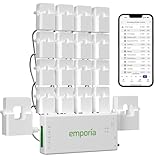
Whole-home energy monitor
Emporia Vue 3 Home Energy Monitor (16 circuit sensors)
Best for: Measuring hardwired and 240 V loads, or every circuit at once
Jump to a section▾
Space conditioning is usually the largest energy load in a home. Estimating yours takes four numbers.
How do you calculate HVAC running cost?
Cost = power (kW) × hours × rate ($/kWh)
For electric equipment — heat pumps, air conditioners, electric resistance heat — this is direct.
For a heat pump, you also need efficiency, because it delivers more heat than it consumes:
Electrical input = heat delivered ÷ COP
Where COP is the coefficient of performance at the relevant outdoor temperature.
A worked example: heat pump heating
A home needing 40,000 BTU/h of heat on a cold day, with a heat pump at COP 2.5 at that temperature:
- 40,000 BTU/h ÷ 3,412 = 11.7 kW of heat delivered
- ÷ 2.5 COP = 4.7 kW electrical input
- Running 12 hours = 56 kWh
- At $0.16/kWh = about $9 for that day
Now the same house on electric resistance heat, COP 1.0:
- 11.7 kW delivered = 11.7 kW electrical input
- 12 hours = 140 kWh
- About $22 for the same day
That 2.5× gap is why auxiliary heat runtime matters so much on a heat pump — see heat pump backup heat explained.
Cooling
Same structure. A 3-ton (36,000 BTU/h) air conditioner at a given efficiency:
- Efficiency ratings translate to power draw: divide capacity by the efficiency figure to get watts
- Multiply by runtime hours and your rate
A modern system running several hours a day in summer heat is a substantial share of the bill. Run yours with the electricity cost calculator.
Which heating fuel is cheapest to run?
The fair comparison is cost per unit of delivered heat, which requires both price and efficiency:
| Source | Efficiency | What to compare |
|---|---|---|
| Heat pump | COP 2–4 (varies with temperature) | Electricity price ÷ COP |
| Electric resistance | 1.0 | Electricity price |
| Gas furnace | 0.80–0.98 AFUE | Gas price ÷ AFUE |
| Oil furnace | 0.80–0.90 | Oil price ÷ efficiency |
| Propane | 0.80–0.95 | Propane price ÷ efficiency |
Two points that trip people up:
Heat pump COP falls with outdoor temperature. A single seasonal number hides that. Compare at your design temperature as well as seasonally.
Fuel prices move. A comparison done three years ago may be wrong now. This is exactly why dual-fuel switchover points should be revisited rather than set once.
Check current rates on the electricity rates by state page.
What makes HVAC run more?
The equipment determines cost per hour. Runtime determines how many hours, and it's driven by the building rather than the machine:
Climate. Heating and cooling degree days for your location. This is why year-over-year bill comparisons need degree-day adjustment before you conclude anything about equipment.
Envelope. Insulation and air sealing determine heat loss and gain. A leaky, poorly insulated house runs its equipment far more for the same comfort.
Ducts. Losses in unconditioned space mean the system runs longer to deliver the same result — frequently the largest single inefficiency. See ductwork problems and cost.
Setpoints and how steadily you hold them.
Solar gain, window area and orientation, and shading.
Reducing it, in order of impact
- Air sealing and insulation. Reduces runtime for every system, permanently. Usually the best return available.
- Duct sealing, if ducts run through unconditioned space.
- Efficient equipment, when replacement is due — a heat pump instead of resistance heat is the biggest single equipment change.
- Correct sizing. Oversized equipment short cycles, dehumidifies poorly, and costs more — see oversized HVAC problems.
- Filter and maintenance discipline. A clogged filter measurably raises consumption.
- Thermostat strategy — with the caveat that deep setbacks can backfire on heat pumps with electric backup. See heat pump thermostat settings.
Notice that the first two are building improvements, not equipment. That ordering surprises people and it's consistently what the numbers support.
Why did my heating bill go up?
Before suspecting the equipment:
- Weather. Compare heating or cooling degree days year over year, not just calendar months.
- Rate changes. Check whether your utility's rate moved.
- Filter. A clogged filter raises consumption and can trigger backup heat.
- Auxiliary heat. If AUX is running more, something changed — see heat pump backup heat explained.
- Refrigerant. A developing leak reduces capacity, so run times grow — see refrigerant leak signs.
- New loads. An EV, a hot tub, a new appliance.
See why is my electric bill so high for a fuller diagnosis, and estimate a whole bill with the electricity bill estimator.
Where to go next
- cost to run an air conditioner
- Heat pump payback calculator
- Estimate and lower your electricity bill
- What is a kWh
More in our heating and cooling guides.
Frequently asked questions
Ask AI about this
Open an AI assistant with a question grounded in this page.